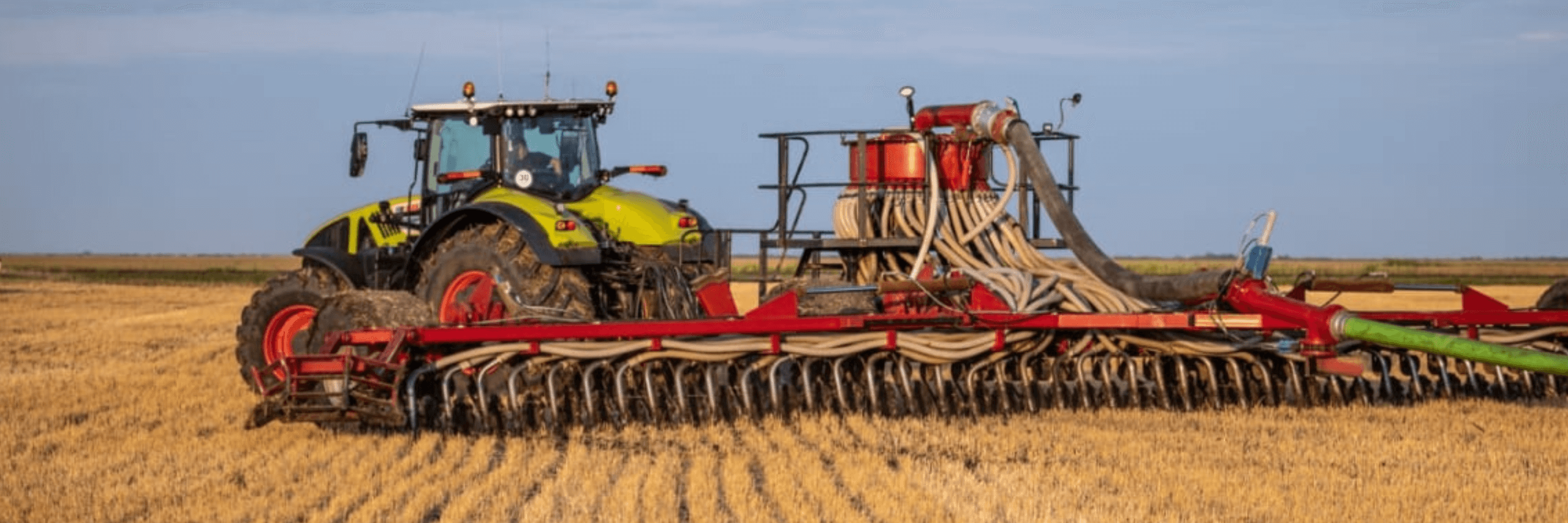

With all the Manure Applicators on the market today claiming to be the Best, I swore I wouldn’t get involved with promoting one over the other. All that changed recently at least with Pull Type Design. A Canadian Company Hydro Ag and their Engineers finally resolved many issues that Pull Type Applicators have. There’s a lot of user-friendly features here along with common sense. Low Rate Per Acre Hog Manure Application has finally been resolved. Please follow the features below and links I have provided and see if you agree.
Various Widths
Choose what width Applicator and Row Spacing is right for you. Applicators are up to 70’ wide, with as narrow as 12” Row Spacing for Coulter Units. Typical HP requirement is 10 HP per Unit. Wider Applicators mean less passes through the field and less wear and tear on your Drag Hose. The Applicator folds to 15’ for road travel.
No Conventional Swing Tube
This unit has a short swing pipe out the back that connects via a Hose to the Manifold, connected with a Live Swivel. No kinks, No Pressure Spikes. No Down Pressure from a Swing Tube that works as a lever and lightens the front end of the Applicator. The Hose goes to the end of the Applicator when turning and into a Hose Humper style cradle that doesn’t crimp or pinch the Drag. These have a hydraulic lift and lower linkage.
Individual Coulters
Salford Coulters are used with their 1.25” Coil Tech Deign. The 20” Wavy Coulter is mounted to a 5” hub and can swivel 26 degrees left or right. Turning with these in the ground presents no issue. Actual field experience shows that with a once a week greasing the Coulters have covered 60,000 acres with no issues. The Coil Tech design allow for 6” vertical travel should objects be encountered.
High Flotation Tires
High Flotation Tires 800/45/26 are utilized to carry the weight of the Applicator, reduce compaction, and roll over the terrain.
Manure Tube
Individual Stainless Steel Manure Tubes are Spring Mounted, and slightly angled for Manure to be placed in the furrow made by the Wavy Coulter and enough soil is being worked up that it covers the Manure and needs no Closure Blades behind it. Coulters are adjustable for depth to about 8”. This system covers completely for no nutrient loss.
Hydraulic Distributor Type Manifold
The Hydraulic Manifold utilizes a Chopping Mechanism internally and thoroughly grinds and chops foreign debris into manageable pieces that easily pass though the 2.5” Hoses. The Hydraulic Manifold is massive and creates pressure to equalized GPM from end-to-end of the Applicator. The added GPM your able to pump keeps the Manifold charged helping distribution.
Fluid Delivery
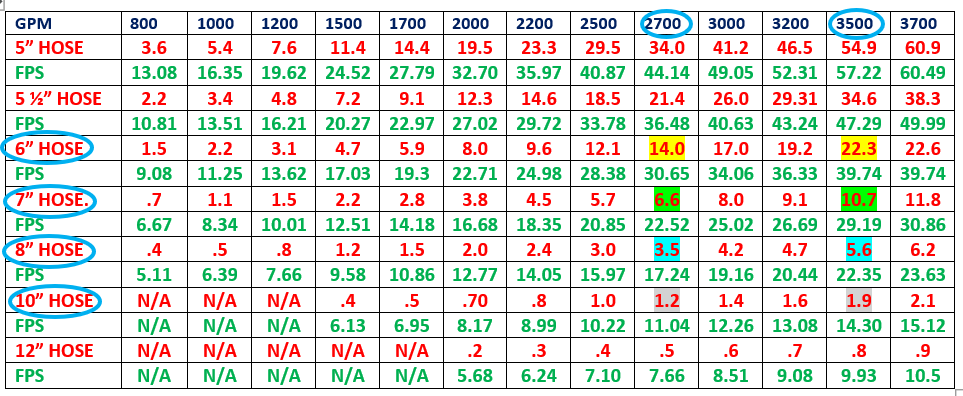
If you want Big Gallons, then you need to consider having your Main Line and Drag Hoses Sized accordingly. Going to a 7’ Drag is almost mandatory to allow low Friction Loss in the Hose. For instance, in a 1,320’ Drag Hose of 6” it requires 200 PSI to push 2,700 GPM through it. While 7” X 1,320’ requires about 107 PSI. There’s no way to push 3,500 GPM through 6” Drag but, 7” X 1,320” requires about 160 PSI. If pushing through 8” Main Line you’ll need a Booster Pump that will produce 2,700 GPM @ 200 PSI every mile. With 10” Lay Flat you’d need to put a Booster every three miles. If attempting 3,500 GPM through 8” place Boosters every 5 lengths or 5/8 mile to achieve it. With 10” you can go two miles before placing a Booster. It all becomes relative Go Big or Go Home. Compare Friction Losses on the Chart I’ve included below.
Pumps
Each situation is going to be different but, you’ll need Pumps and Power Units capable of the GPM you’re shooting for and the PSI necessary. I’ll be glad to run the calculations and share some ideas with you as well as how to get there.
Stop Burning Up Your Drags
Speed Kills, when it comes to Drag Hoses, if you’re traveling over 5.0 MPH you’re going to fast.
 507-327-4081